
Author's note: Ironbridge Industrial and Maya are fictional. Every problem in this story is not. It is a composite of situations I have watched play out inside real B2B companies. If you lead marketing, you will probably recognize your own org chart somewhere in here.
Act 1: The Fog
On her first Monday as VP of Marketing at Ironbridge Industrial, Maya Reyes asked a simple question.
"How many people are in marketing?"
Nobody could answer it on the first try.
Ironbridge made pumps, valves, and flow-control systems. It brought in $4 billion a year through seven business units, built over two decades of acquisitions. Each acquisition brought its own marketing team. Nobody had ever merged them.
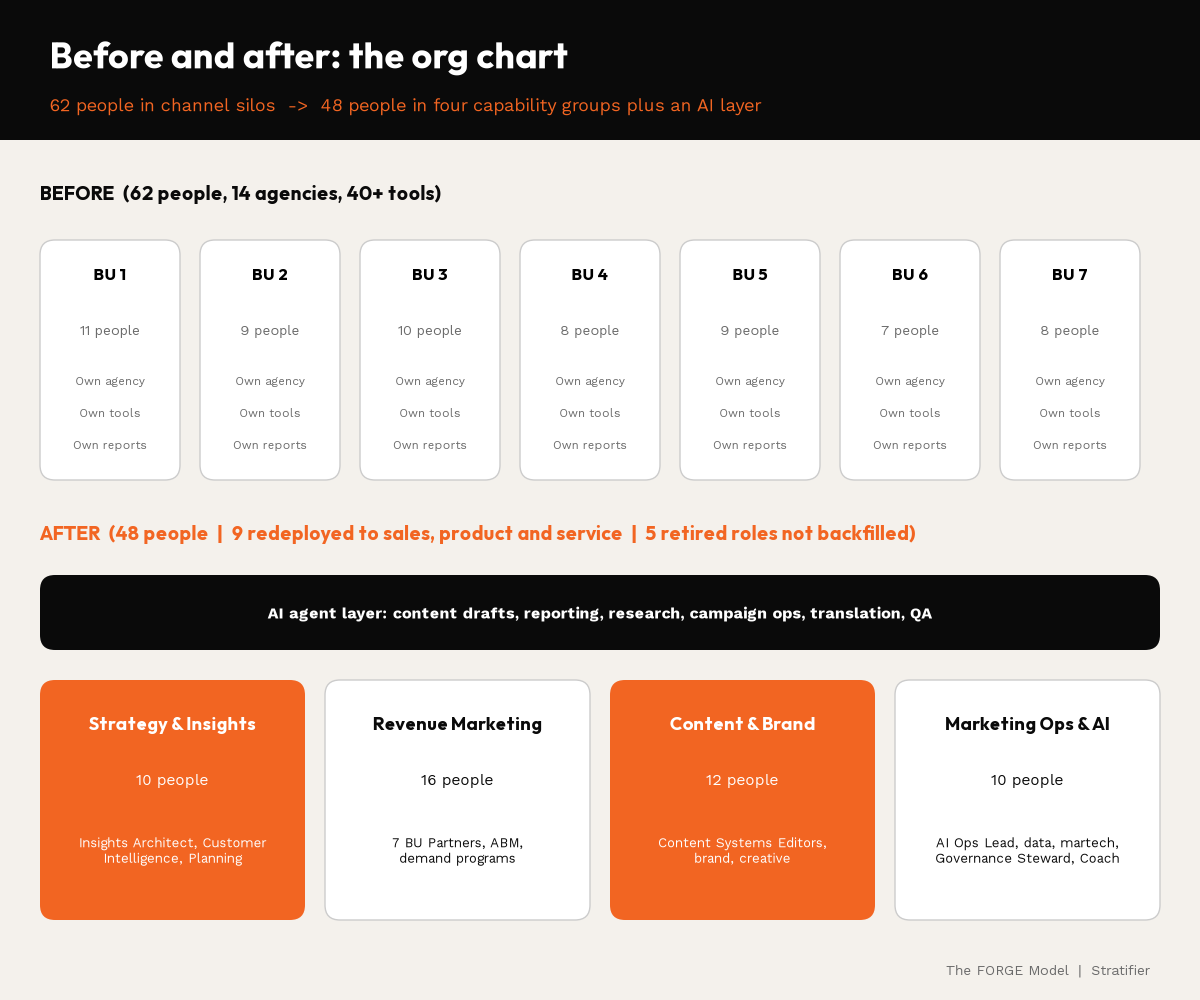
By Friday, Maya had her count: 62 marketers. They worked with 14 agencies and paid for 43 software tools. The budget was $38 million. Three teams had built three different websites for the same product line. Two business units were running trade show booths at the same event, 200 feet apart.
Then the CFO stopped by her office.
"I'm going to be straight with you," he said. "The board wants to know what we get for $38 million. Last year the answer was a 140-page deck of open rates. Nobody read it."
That night, Maya wrote three sentences in her notebook:
We are not short on people. We are short on clarity. AI won't fix a broken structure. It will just make the broken parts move faster. Rebuild the structure first, then let the tools multiply it.
Maya knew the easy move. Every consultant pitch she got in her first month said the same thing: "AI can cut your team by 40%." Spreadsheets were already floating around with names highlighted in yellow.
She closed them.
"If I start with headcount, I'll get a smaller version of the same mess," she told her CEO. "Give me 90 days to map the work. Then I'll bring you a structure."
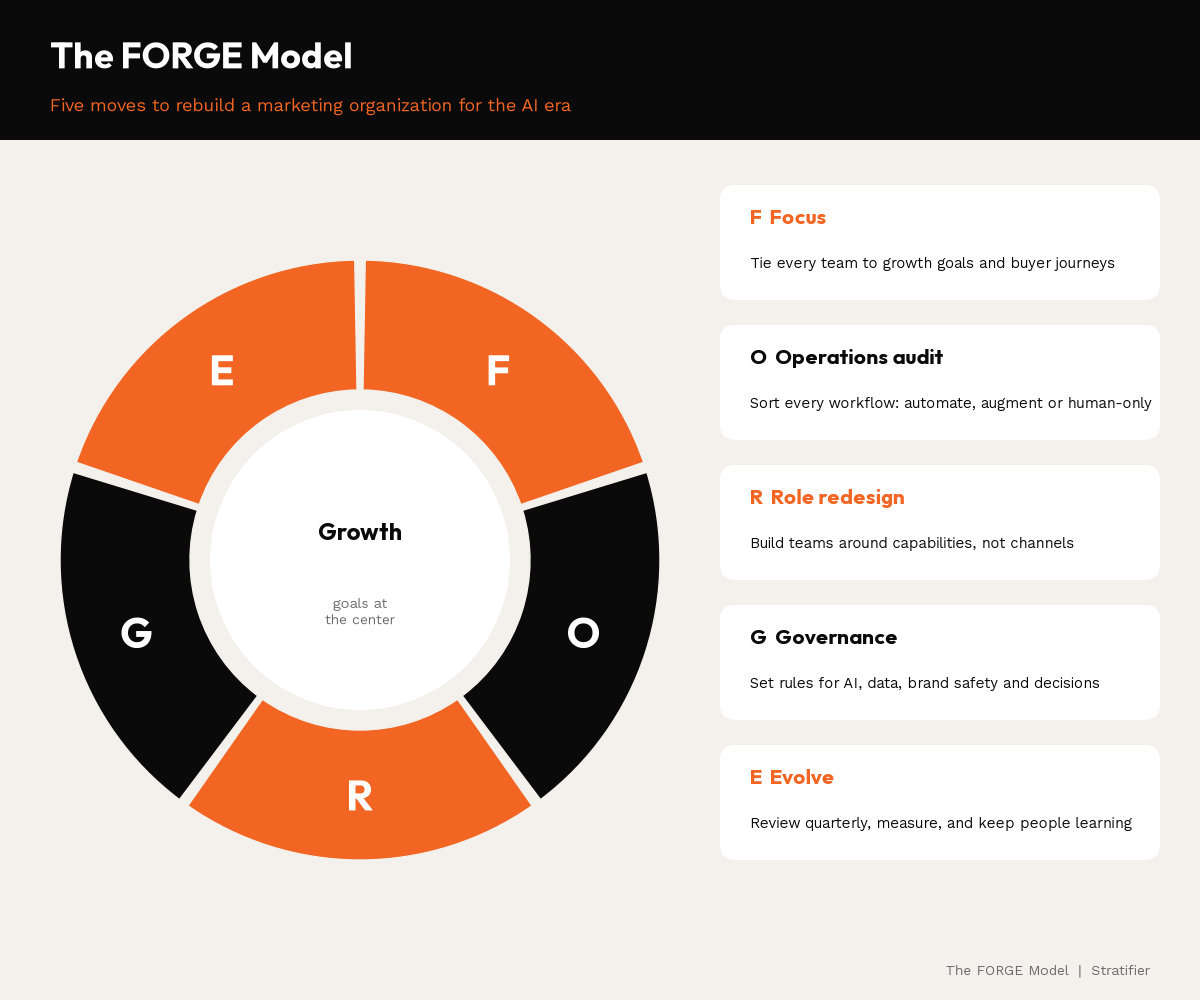
She called her approach FORGE, because the plan was to reshape something strong, not throw it out.
 FORGE
F: Focus
Maya started with the company's growth plan, not the marketing plan. Ironbridge wanted to grow aftermarket service revenue from 22% to 35% of sales and break into two new regions. She turned those goals into four buyer journeys: plant engineers, procurement leaders, distributors, and service managers.
Then came the hard question: which of our 62 people work on those four journeys? About half did. The rest worked on things that made sense in 2015.
O: Operations audit
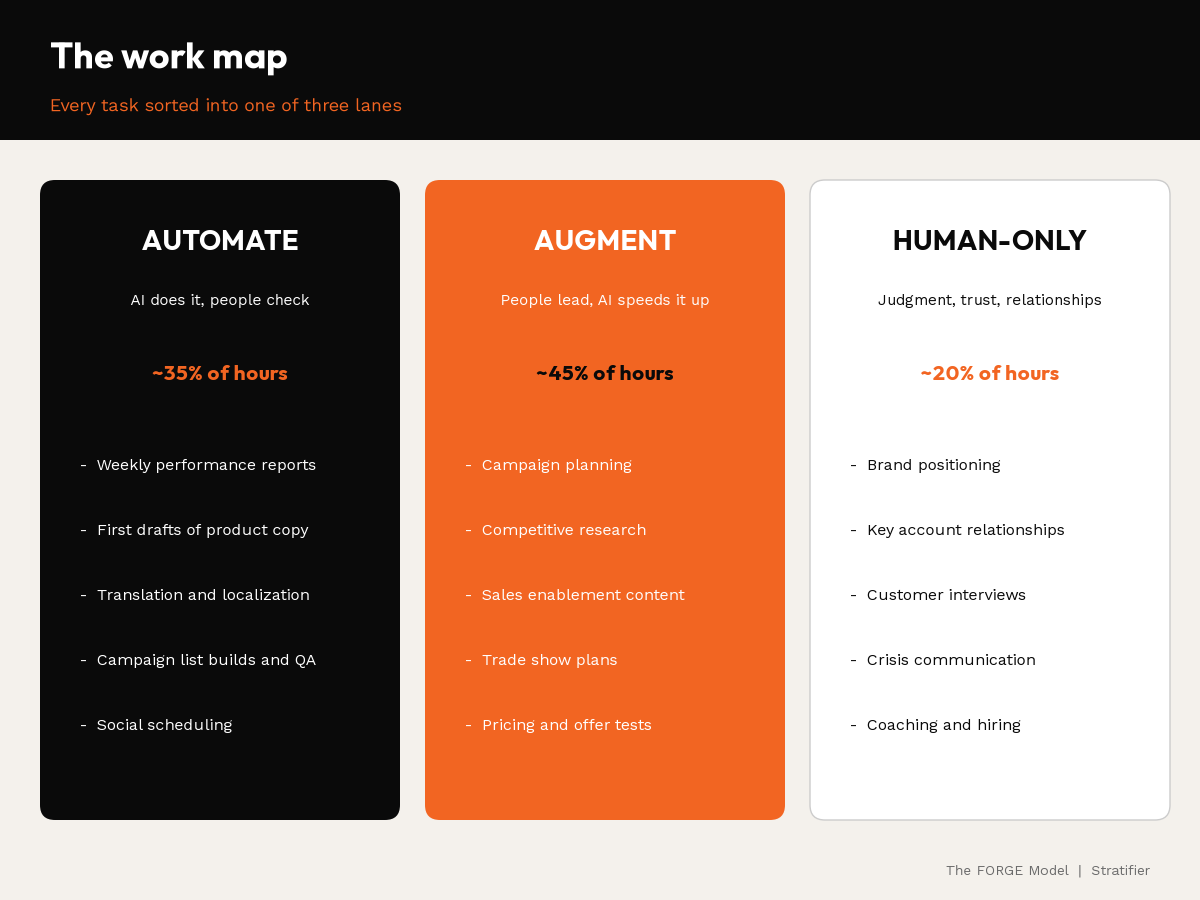
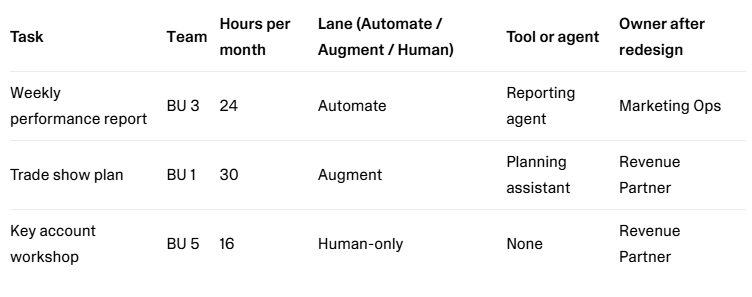
Next, every person logged their work for two weeks. Maya's team collected more than 1,100 tasks and sorted each into one of three lanes:
- Automate: AI does it and a person checks it.
- Augment: a person leads and AI speeds it up.
- Human-only: judgment, trust, and relationships
 The Work Map
The result surprised everyone. About 35% of all hours went to work AI could already handle well: weekly reports, first drafts of product copy, translations, and list builds. Another 45% could go two to three times faster with AI support. Only 20% truly needed a person from start to finish.
"So the problem isn't that we have too many people," said Dev, a 19-year Ironbridge veteran who ran trade shows. "It's that our people spend most of their week on the wrong work."
"Exactly," Maya said. "And the 20% that's human-only is where we win."
R: Role redesign
Maya threw out the old structure of seven business-unit teams, each with its own channel specialists. She built four groups around capabilities:
- Strategy and Insights: what the market needs and where we should play
- Revenue Marketing: campaigns and programs tied directly to sales
- Content and Brand: one voice, one brand system, one quality standard
- Marketing Operations and AI: data, tools, agents, and governance
Underneath all four sat a new layer: AI agents running the repeatable work.
 Org Chart
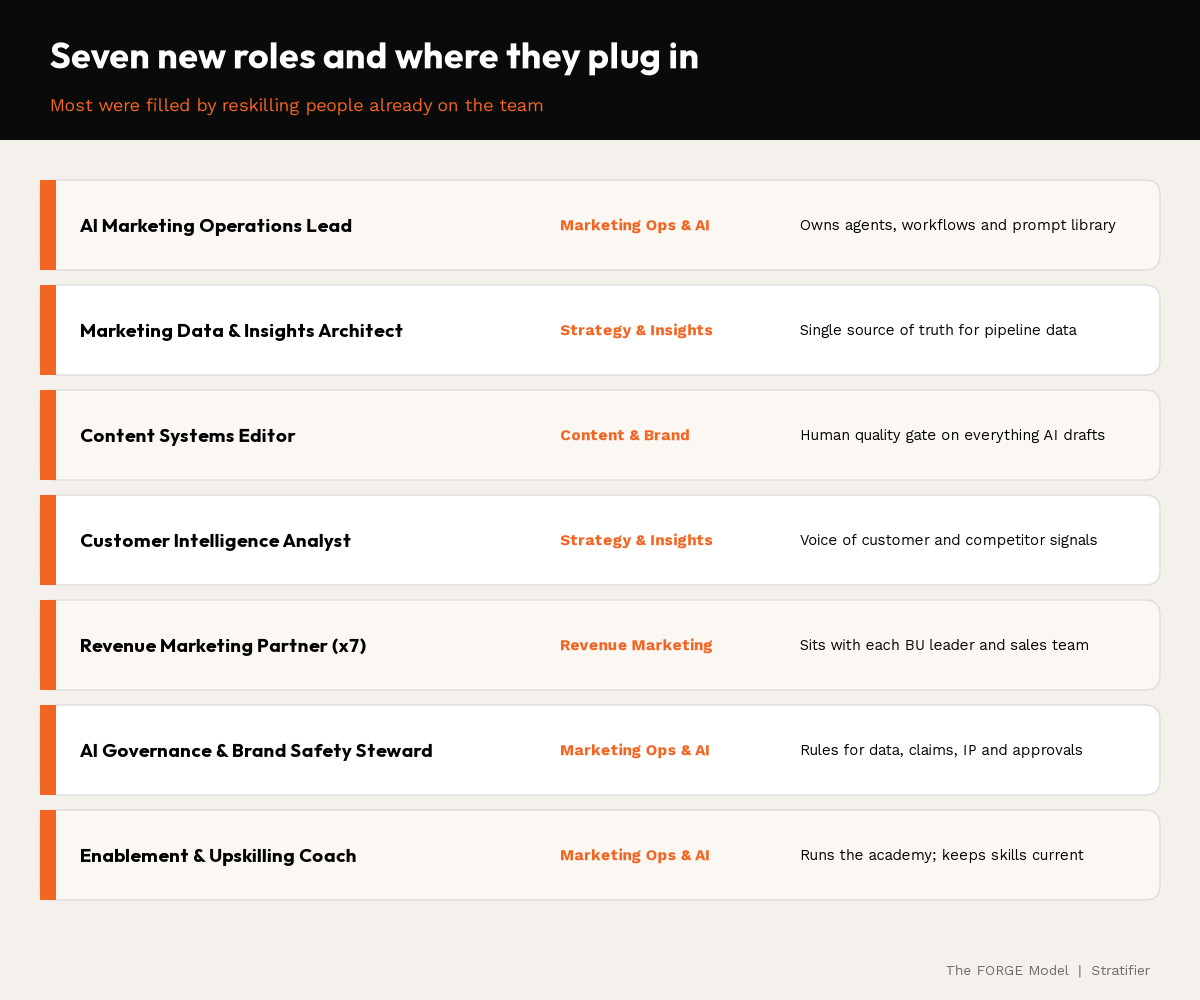
Then she created seven new roles. Five went to people already on the team.
 New Roles
- AI Marketing Operations Lead. Maya hired this person from outside. They own the AI agents, workflows, and prompt library. This is the "plant manager" for the marketing factory.
- Marketing Data and Insights Architect. Also an outside hire. Their job is to create one source of truth for customer and pipeline data, because AI is only as good as the data it eats.
- Content Systems Editor. Three senior copywriters moved into this role. They don't write every word anymore. They set the standards, shape the AI drafts, and are the final quality gate before anything ships.
- Customer Intelligence Analyst. A former market researcher who now runs voice-of-customer interviews and tracks competitor signals every week.
- Revenue Marketing Partner (x7). One per business unit. Each partner sits in the BU leader's staff meeting and in the weekly sales pipeline review. They are marketing's ambassador and sales' teammate.
- AI Governance and Brand Safety Steward. This person writes the rules: what data AI can touch, which claims need legal review, and who approves what. In an industrial company where a wrong pressure rating in an ad becomes a liability, this role mattered more than anyone expected.
- Enablement and Upskilling Coach. Runs the "Ironbridge Marketing Academy," where everyone learns AI tools, data basics, and new ways of working.
Dev became one of the Revenue Marketing Partners. "I spent 19 years planning booths," he said. "Turns out what I was really good at was knowing which customers showed up and why."
G: Governance
Before turning on a single agent, Maya made the team agree on the rules:
- A short AI use policy: approved tools, data rules, and what always needs a human review
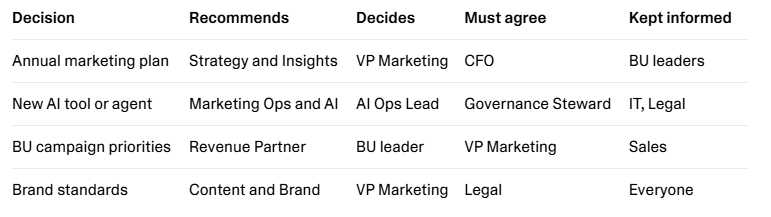
- A decision chart showing who recommends, who decides, and who gets informed for every major type of work
- A brand and claims checklist built into every AI workflow
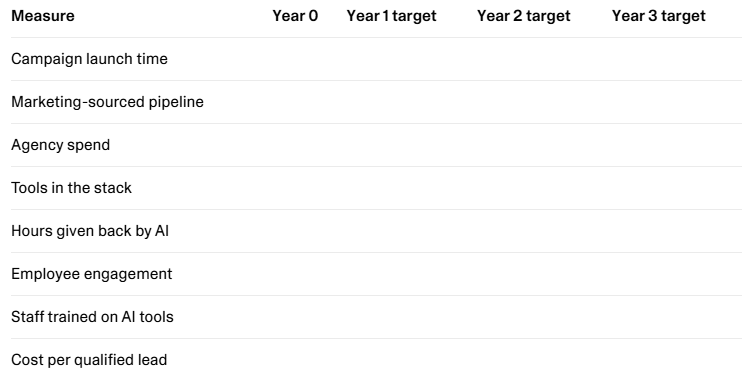
- One dashboard with eight numbers the CFO cared about, instead of a 140-page deck
E: Evolve
Finally, Maya set a rhythm. Every quarter, the leadership team would review the FORGE map: What moved from augment to automate? Which skills are we missing? What should we stop doing? The structure was never meant to be finished. It was meant to keep learning.
Act 3: The Rebuild
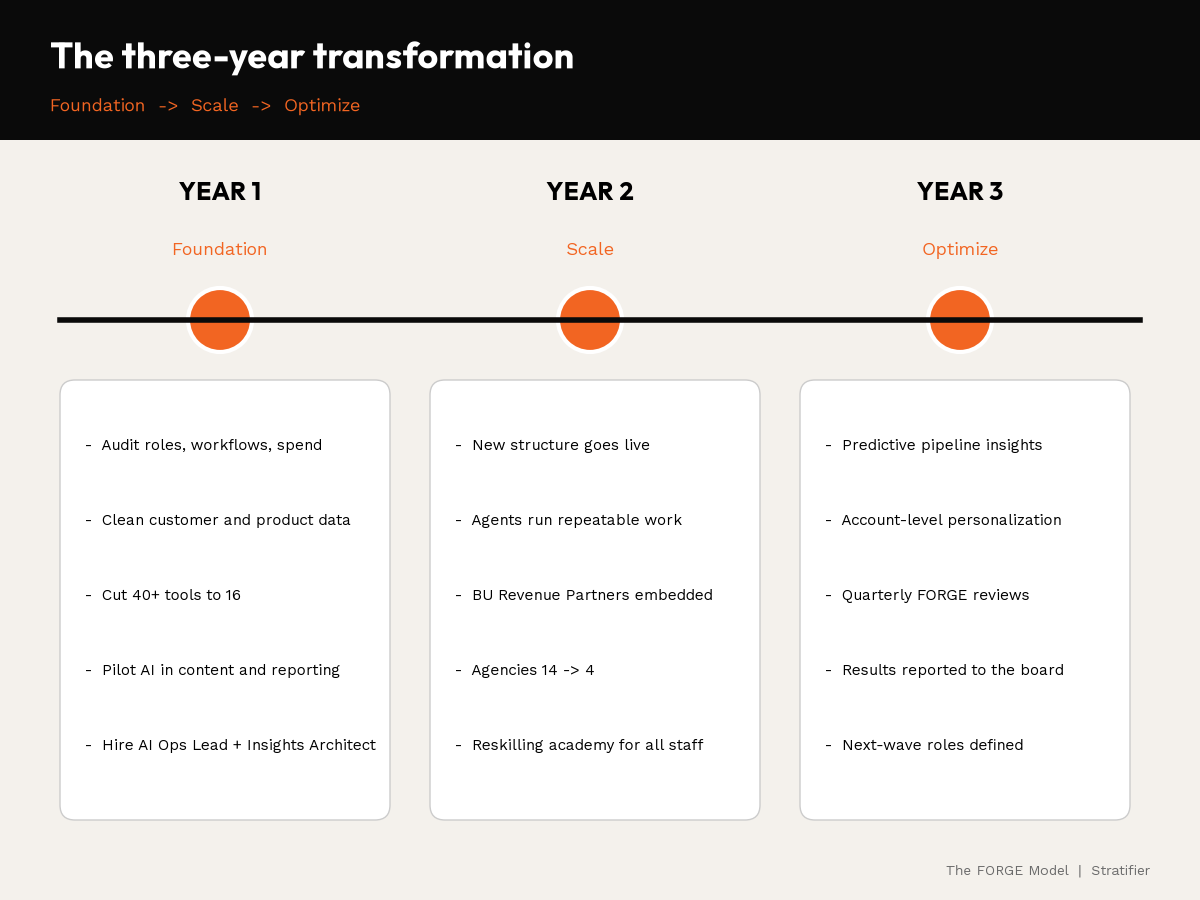
Maya laid out a three-year plan and presented it to the board on one slide.
 Three-year transformation
Year 1: Foundation
The first year wasn't exciting, and it wasn't supposed to be. The team cleaned up 11 years of messy customer data, cut the tool stack from 43 to 16, and ran AI pilots in two places only: product content and weekly reporting.
The reporting pilot alone gave back 1,900 hours in six months. Maya didn't cut those hours. She reinvested them in customer interviews, and those interviews changed the aftermarket service message completely.
There were hard moments. Two agency relationships ended badly. A pilot that wrote technical spec sheets made a mistake about a valve tolerance, and the Governance Steward caught it before it went out. That near-miss did more to build trust in the review process than any memo could have.
Year 2: Scale
The new structure went live in January. Revenue Marketing Partners joined BU staff meetings. AI agents took over first drafts, translation into nine languages, campaign list builds, and performance reporting. Fourteen agencies became four, each with a clear job.
Not everyone stayed. Nine people moved into roles in sales, product management, and customer service, where their product knowledge was gold. Five open roles were left unfilled. Nobody was walked out the door because of a chatbot. That fact spread quickly, and it changed how the team felt about everything.
Year 3: Optimize
By Year 3, the team used predictive models to spot which accounts were likely to need service before the customer called. Campaigns were personalized for each target account, not just each industry. The quarterly FORGE review became a normal part of how the team worked.
Act 4: The Results
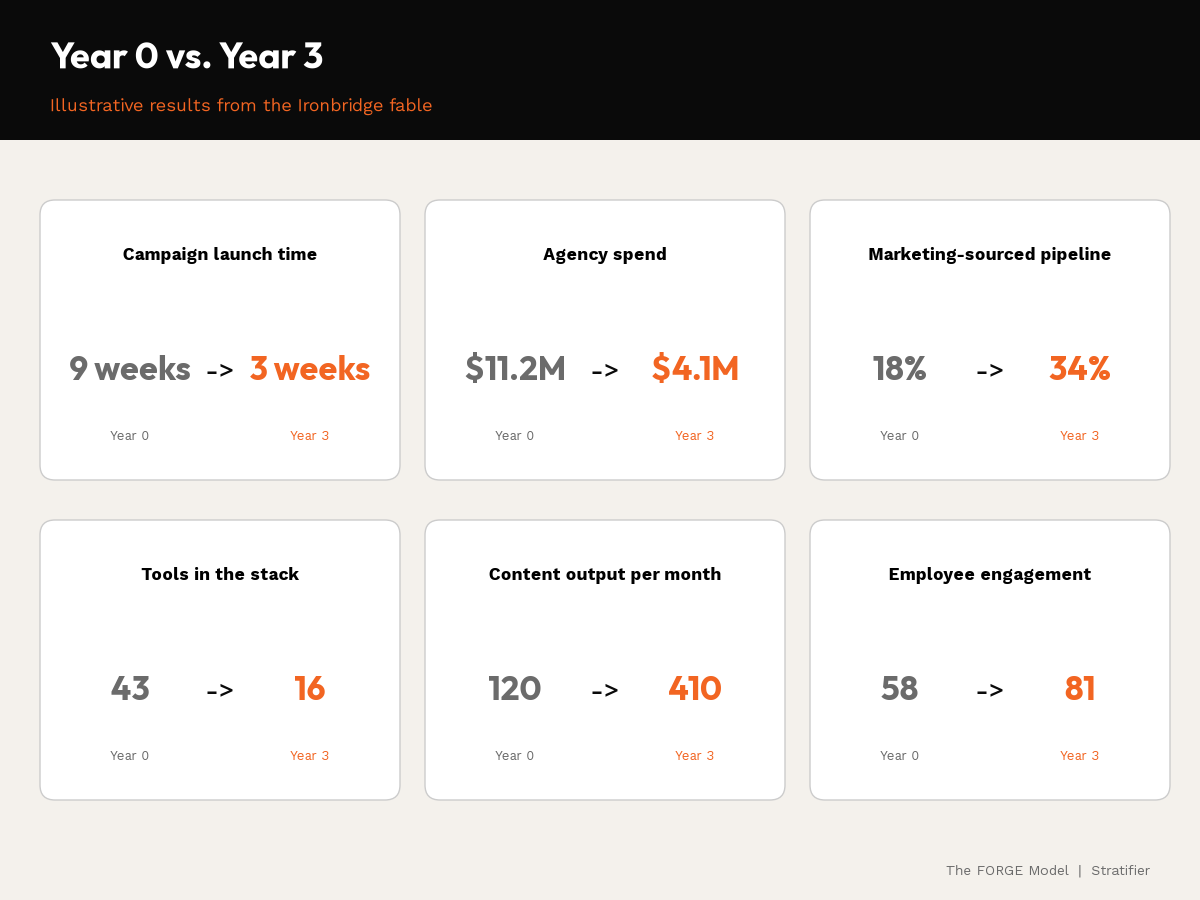
At the end of Year 3, the CFO asked for the board update again. This time it was one page.
 Year 0 vs. Year 3
- Campaign launch time: 9 weeks to 3 weeks
- Agency spend: $11.2M to $4.1M
- Marketing-sourced pipeline: 18% to 34%
- Tools: 43 to 16
- Monthly content output: 120 to 410 pieces
- Employee engagement score: 58 to 81
The total budget barely moved. What changed was where the money and people went.
The CFO read the page twice and then said the line Maya still repeats: "This is the first time marketing has felt like a growth investment instead of an expense line."
The moral
AI didn't transform Ironbridge's marketing team. Maya did. AI was the force multiplier. The real work was the courage to rebuild the structure, the discipline to map the work before cutting anything, and the respect to bring her people along.
Three lessons for any marketing leader:
- Map the work before you touch headcount. You can't redesign what you can't see.
- Organize around capabilities, not channels. Channels change every year. Capabilities compound.
- Make governance and reskilling first-class jobs. They're what make speed safe and change stick.
The FORGE Planning and Implementation Guide
Use this guide to start your own transformation. A printable version with fill-in templates is available as a PDF download.
1. Your 90-day kickoff checklist
Days 1 to 30: See the whole picture
- Count every person, agency, tool, and dollar in marketing
- Get the company growth plan and turn it into 3 to 5 buyer journeys
- Interview the CEO, CFO, head of sales, and every BU leader
- Name a small transformation team (4 to 6 people across levels)
Days 31 to 60: Map the work
- Run a two-week work log with every team member
- Sort every task: automate, augment, or human-only
- Score each team's skills against the capabilities you'll need
- Pick two low-risk AI pilots with clear time savings
Days 61 to 90: Design and commit
- Draft the capability-based structure and new roles
- Write the AI use policy and decision chart
- Build the three-year roadmap and the eight-number dashboard
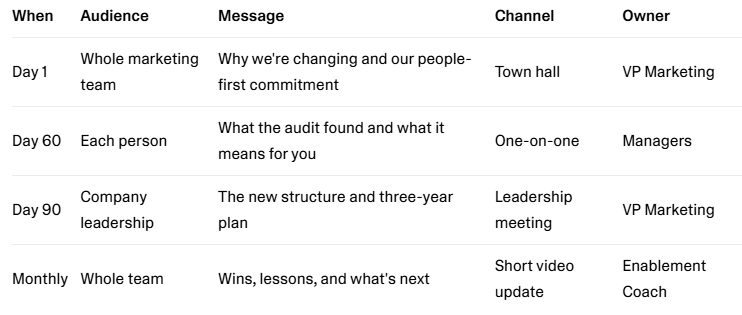
- Present to leadership and announce a people-first commitment
2. Work audit template
3. Role redesign worksheet
For each new role, answer:
- Purpose: Why does this role exist, in one sentence?
- Outcomes: Which 3 numbers will this person move?
- Plugs into: Which group, which BU leaders, which agents?
- Skills needed: Rate today's best internal candidate from 1 to 5 on each.
- Source: Reskill, redeploy, or hire?
4. Skills gap scorecard
Rate each team from 1 (none) to 5 (expert) on: data literacy, AI tool use, prompt and workflow design, customer insight, commercial acumen, content quality judgment, and change leadership. Any score below 3 becomes a training priority for the academy.
5. AI tool selection checklist
- Solves a task already marked "automate" or "augment"
- Works with your existing customer data and content systems
- Meets your security, privacy, and data-residency rules
- Keeps a record of what it produced and who approved it
- Has a clear owner and a measurable time or cost saving
- Can be removed without breaking anything else
6. AI governance policy starter
- Approved tools: Only tools on the approved list may use company data.
- Data rules: No customer personal data or unreleased pricing goes into public AI tools.
- Human review: All technical specs, safety claims, pricing, and legal statements need human sign-off.
- Transparency: Keep a log of every AI-assisted asset and who approved it.
- Ownership: The Governance Steward updates this policy every quarter.
7. Decision chart (who does what)
8. Change and communication plan
9. Three-year KPI scorecard
Where to get help
You don't have to do this alone. A Certified Stratifier can guide you through every FORGE step, using the Stratifier CMO Toolbox to run the work audit, build the role plans and roadmap, and track quarterly progress, all at a fraction of the cost of a large consulting engagement. The COO Toolbox contains the FORGE AI Transformation Playbook to apply to any department in your business.