

The State of AI in B2B Business, 2026 Q4 · Edition 1. Seven sectors: who's winning, what's holding the rest back, and the early signals that separate them.
Download the full report (PDF)
The State of AI Index
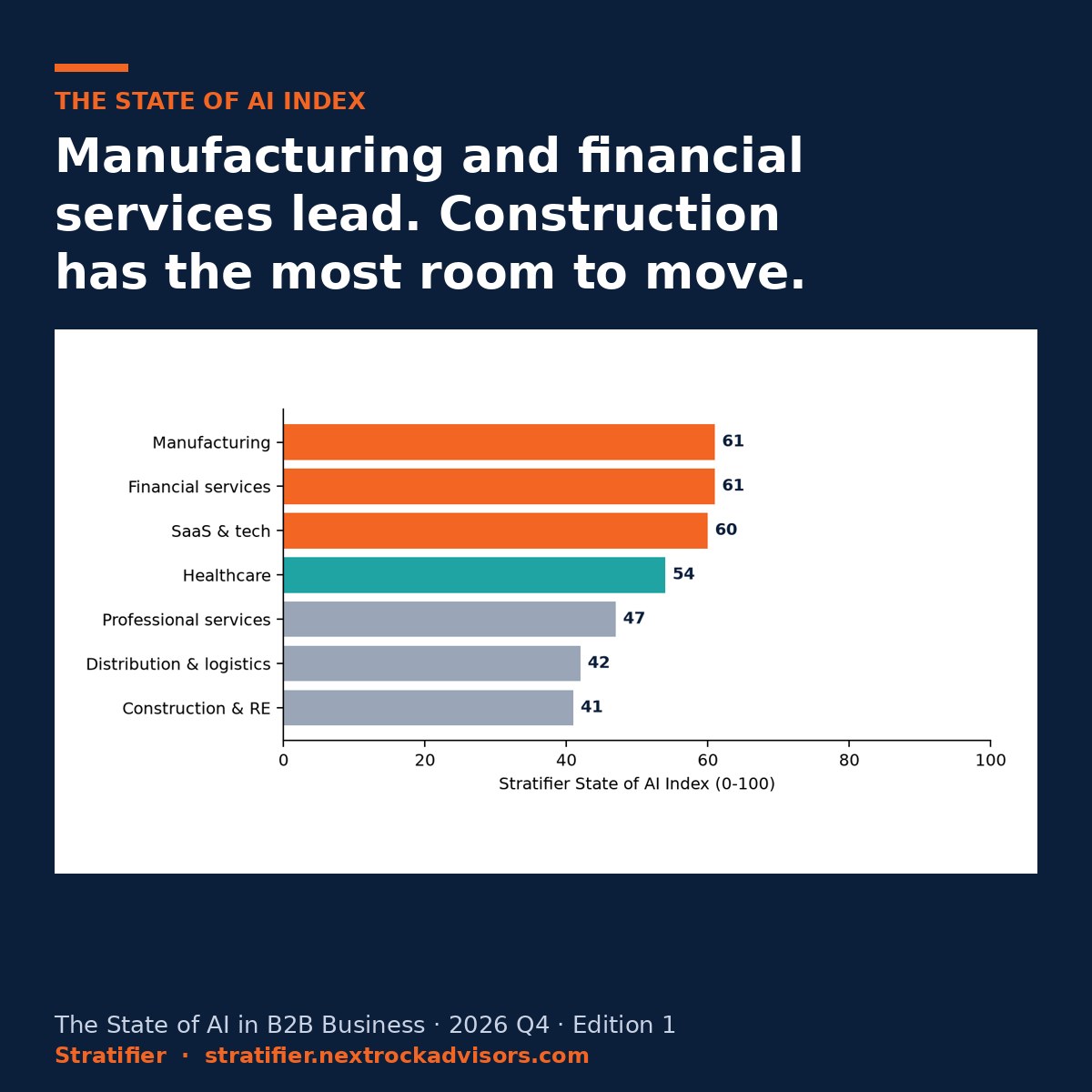 Manufacturing and financial services lead; construction has the most room to move.
| Sector | Index | Tier | Change |
|---|---|---|---|
| Manufacturing & industrial | 61 | Leader | Baseline |
| Financial services | 61 | Leader | Baseline |
| SaaS & technology | 60 | Leader | Baseline |
| Healthcare | 54 | Scaling | Baseline |
| Professional services | 47 | Emerging | Baseline |
| Distribution & logistics | 42 | Emerging | Baseline |
| Construction & real estate | 41 | Emerging | Baseline |
The index weights adoption in production (25%), value realized (20%), investment, talent and data readiness (15% each), and lighter regulatory, trust and cost drag (10%). The formula is fixed so quarter-to-quarter movement is real.
What changed this quarter
- Enterprise AI scaling became the central operating challenge. AI moved further from isolated experimentation toward enterprise scaling: 44% of surveyed organizations reported scaling AI across the enterprise, up from 38% a year earlier. The shift makes governance, integration, and measurable operating outcomes more important than adding pilots.
- Agentic AI moved into scaled workflows. Agentic AI became a material enterprise deployment category, especially among large organizations. Forty percent of respondents from organizations with more than $1 billion in revenue reported scaling AI agents, versus 27% the prior year.
- The AI scale gap widened. Smaller organizations did not match the large-enterprise acceleration: the share reporting scaled agents remained 22%. Mid-market companies therefore face a widening execution gap rather than a simple technology gap.
- Agentic coding challenged software procurement. Agentic coding began changing the build-versus-buy decision. Thirty-two percent of surveyed organizations said they had rejected at least one software product or feature because it could be built internally with agentic coding tools.
- AI became a major technology-budget category. AI budgets became a more substantial part of technology spending: 28% of respondents said AI represented more than 10% of their enterprise-wide ICT budget. This raises the need for chargeback, utilization, and value-realization controls.
- AI investment expectations continued rising. Investment momentum remained strong, with 60% of respondents expecting their organizations to increase AI investment over the following year. Budget growth is increasingly tied to scaling proven use cases rather than experimentation alone.
- AI reshaped workforce planning. Workforce effects became more visible but remained uneven: 14% of organizations using AI reported an overall workforce decline attributable to AI during the previous year, compared with 32% reporting workforce increases. Workforce planning therefore needs augmentation and redeployment measures, not only reduction scenarios.
- EU AI Act enforcement began. The EU AI Act reached a major compliance date on 2 August 2026. Enforcement began for applicable provisions, including prohibited practices, transparency requirements, and general-purpose-AI obligations; the Act’s broader rollout continues progressively through 2028.
- Agentic systems entered existing AI governance rules. The EU framework explicitly covers AI agents through its general definition of an AI system and general-purpose-AI provisions, even though agents are not a separate legal category. Agent deployments therefore require classification, documentation, transparency, and oversight analysis.
- EU AI compliance implementation was adjusted. The 2026 EU AI Omnibus changed implementation conditions, including simplifications affecting smaller companies and startups. Mid-market firms still need legal review because obligations depend on role, system risk, market placement, and use case—not company size alone.
Manufacturing & industrial: 61 (Leader)
Industrial AI is in production—but the 2026 bottleneck is scale and P&L proof, not experimentation.
By Q4 2026, AI adoption in B2B manufacturing has moved decisively from experimentation toward operational deployment, but not yet broad scale. Deloitte reports that 84% of manufacturers generate measurable value from AI, while only 20% of use cases are scaled; Grant Thornton separately reports that 93% of manufacturing leaders run AI in production environments. The evidence is therefore strongest for widespread production use and early operational value, not for consistently material financial returns. Adoption is concentrated in quality, production, maintenance, logistics and planning, with security, data readiness, integration and change management limiting multi-site expansion.
What's holding it back: Scaling pilots across plants and workflows; Cybersecurity, safety and operational resilience; Poor data infrastructure and system integration.
Biggest opportunities: AI quality and inspection; Maintenance and asset performance; Scheduling and planning.
Who wins: Winners combine a high-value operational use case with reliable plant data, deep integration into MES/ERP/automation workflows, strong cybersecurity and safety controls, frontline adoption, and a financial owner accountable for measurable KPI improvement. They scale a small number of repeatable patterns across sites instead of accumulating disconnected pilots
Early signals:
- The percentage of AI use cases moving from pilot to production and from single-site deployment to multi-site rollout.
- Whether manufacturers begin reporting measurable revenue, cost, throughput, quality or working-capital effects rather than activity metrics.
- Growth in AI-related orders and recurring software/service revenue at industrial-automation vendors such as Siemens, ABB and Schneider Electric.
Financial services: 61 (Leader)
AI is becoming standard infrastructure in financial services—but production scale, not pilots, separates the leaders from the laggards
As of October–November 2026, AI adoption in B2B financial services has moved from experimentation toward broad operational use, but maturity remains uneven. Surveys report 81% of financial-services firms adopting AI at some level, 87% of middle-market respondents at least partially integrating it, and 41% reporting full integration. Adoption is strongest in software development, process automation, fraud/AML, customer service, underwriting, and decision support; agentic AI is advancing faster than legacy governance and infrastructure, with only 10% implementing agents at scale in Capgemini’s survey. Evidence of ROI is improving—98% of institutions in the IIF-EY survey reported measurable benefits—but the results are survey-based and should not be interpreted as proof that most deployments generate material enterprise-level returns.
What's holding it back: Regulation, model risk and accountability; Legacy data and technology architecture; Trust, accuracy and liability.
Biggest opportunities: Fraud and AML productivity; Service and operations copilots; Underwriting and claims intelligence.
Who wins: Winners combine a high-value workflow with proprietary or well-governed data, direct integration into systems of record, measurable operating metrics and strong controls. They use AI to augment accountable professionals first, then automate bounded tasks where accuracy, permissions, monitoring and rollback are demonstrable
Early signals:
- Agentic AI moving from pilots into controlled production—especially payments, servicing, operations and claims—rather than merely increasing pilot counts. The IIF-EY survey says roughly 70% report agentic AI moving from development into production, while Capgemini reports only 10% implementing agents at scale; the gap is a useful measure of whether adoption is truly scaling.
- Evidence of repeatable financial impact: cost-to-serve, loss ratio, fraud loss, underwriting turnaround, revenue per advisor, conversion and capital-efficiency metrics disclosed consistently rather than broad claims of productivity.
- Regulatory and supervisory guidance on high-risk generative and agentic use cases, including model inventories, third-party accountability, human override and customer disclosure.
SaaS & technology: 60 (Leader)
AI is entering production across B2B SaaS—but the winners will be the companies that convert deployment into measurable workflow economics
AI adoption in B2B SaaS and technology is moving decisively from experimentation into production, but deployment is outpacing repeatable economic value. A 2026 enterprise survey reports 74% of respondents have at least one AI solution live, while Deloitte finds only 25% have moved at least 40% of experiments into production and just 22% have scaled across multiple business units. Technology/software appears relatively advanced, with one 2026 study estimating 3.8x three-year ROI, but broader evidence shows that measurable EBIT impact remains modest and uneven. The sector’s next phase will be defined less by model access than by data integration, workflow redesign, governance, pricing, and proof of customer-level ROI.
What's holding it back: Unclear or unmeasured ROI; Data fragmentation and weak readiness; Skills and change-management gaps.
Biggest opportunities: Workflow agents; AI control plane; System-of-action SaaS.
Who wins: Winners will have a high-frequency workflow, privileged proprietary data, deep integrations, strong identity and permission controls, reliable evaluation, and a credible path from usage to customer ROI. They will redesign packaging and pricing around completed work or business outcomes, not merely tokens or seats
Early signals:
- The share of AI experiments reaching production: Deloitte reports 25% have moved at least 40% of experiments into production, while 54% expect to reach that threshold within three to six months.
- Cross-business-unit scaling: Gartner data reported by TechTarget puts successful multi-business-unit scaling at only 22%.
- AI-linked financial outcomes: McKinsey reports 39% attribute some EBIT impact to AI, but most say AI contributes less than 5% of EBIT.
Healthcare: 54 (Scaling)
Healthcare AI crosses the pilot-to-production line—but hard-dollar workflow proof separates winners from expensive experiments
As of October-November 2026, B2B healthcare AI has moved from experimentation toward scaled deployment, but “adoption” is still measured inconsistently: strategy, projects, pilots, and production use are often conflated. Bain/KLAS reports that roughly 70% of providers have an AI strategy in place or in development, while Guidehouse/HIMSS reports 78% of surveyed provider decision-makers are engaged in AI projects. Provider priorities are concentrated in revenue-cycle management, clinical documentation, and workflow automation, where benefits can be tied to denials, coding accuracy, throughput, and labor productivity. ROI evidence is becoming more positive—Vizient reports a 3.2x mean self-reported ROI—but the figures are estimates, not audited results, and smaller practices remain much less advanced than large health systems.
What's holding it back: Security, privacy, and trust; Workflow and legacy-system integration; Unclear or changing regulation.
Biggest opportunities: AI-enabled RCM; Ambient documentation; Workflow automation.
Who wins: Winners will be workflow-native rather than demo-native: they will integrate with EHR and revenue-cycle systems, keep clinicians or operators in accountable control, provide strong privacy and audit trails, and prove value in operational metrics such as denial rates, documentation time, throughput, staffing intensity, and cash collection. They will sell implementation and change management—not just models—and use narrow, high-frequency use cases where data feedback improves performance
Early signals:
- The share of incremental AI budgets allocated to deployment, workflow integration, and scaling rather than discovery; Bain reports 35% directed to scaling proven use cases and 20% to integration.
- Whether RCM and clinical-workflow deployments produce audited improvements in denial rates, coding yield, labor cost, and cash collection—not merely vendor-reported ROI.
- Growth in semi-autonomous or autonomous agents that operate inside production workflows; Bain reports 67% of surveyed provider solutions already running as semi- or fully autonomous agents.
Professional services: 47 (Emerging)
AI is becoming standard infrastructure in professional services—but measurable value, not access, separates winners from expensive pilots.
As of Q4 2026, AI adoption in B2B professional services has moved from experimentation toward mainstream organizational deployment, but production depth and measurable value remain uneven. Thomson Reuters reports that 40% of surveyed organizations across legal, tax, accounting, risk, fraud, and government now use AI, up from 22% in 2025, while 15% have adopted an agentic-AI tool. Individual use is ahead of formal enterprise governance: 41% of professionals reported using public GenAI tools in the 2025 survey, but only 20% said they knew their organization measured GenAI ROI. The strongest near-term winners will be firms that combine proprietary data, workflow integration, human review, pricing innovation, and disciplined ROI measurement rather than merely providing employees with generic chatbots.
What's holding it back: Trust, accuracy, confidentiality, and professional liability; Weak ROI measurement and unclear monetization; Workflow and data integration.
Biggest opportunities: Workflow copilots; Agentic operations; Proprietary-data intelligence.
Who wins: Winners will be trusted domain platforms and services firms that own or can securely access high-quality proprietary data; embed AI into production workflows; maintain human accountability and audit trails; train professionals continuously; and price around client outcomes rather than hours. They will run a portfolio of narrowly scoped use cases with baseline measurements, expand only where quality and economics are proven, and use AI both to lower delivery cost and to create higher-value recurring services
Early signals:
- The share of organizations using AI rises above the 40% reported by Thomson Reuters, while agentic-AI adoption moves beyond the reported 15% baseline.
- Professional-services firms begin reporting revenue, realization, margin, or client-retention benefits rather than only time savings and user adoption.
- Large firms disclose AI-related changes to leverage models, junior hiring, utilization, billing, or pricing in earnings calls and annual reports.
Distribution & logistics: 42 (Emerging)
AI is moving through logistics—but scale and measurable ROI remain the real bottlenecks
As of October-November 2026, AI adoption in B2B distribution and logistics has moved decisively beyond experimentation, but scaled, repeatable value remains limited. Logistics providers are progressing faster in pilots and selected operational deployments than in enterprise-wide production: roughly 40% have moved beyond pilots, yet only about 10% have embedded AI into core operations at scale. Shippers and distributors report broader use of individual use cases—especially forecasting, customer service, transportation planning, visibility, and warehouse applications—but distribution-specific research still places the average market between “not considering” and “evaluating” AI. The central 2026 pattern is a widening gap between perceived AI value and realized financial returns.
What's holding it back: Unclear ROI and weak business cases; Shortage of internal AI and transformation skills; Poor data quality, fragmentation, and integration.
Biggest opportunities: AI forecasting and replenishment; Transport optimization and execution; Warehouse operations intelligence.
Who wins: Winners will be operators that select a small number of economically important workflows, connect AI directly to ERP/WMS/TMS and frontline processes, and instrument outcomes such as forecast error, inventory turns, transport cost, warehouse productivity, service level, and exception-resolution time. They will pair domain experts with scarce AI talent, use human-in-the-loop controls for high-consequence decisions, and build reusable data and governance foundations instead of isolated pilots
Early signals:
- The share of logistics providers embedding AI into core operations: a move materially above the current roughly 10% baseline would indicate transition from experimentation to scaling.
- Whether measurable financial impact rises above the current approximately 10%-13% range in provider surveys.
- Distribution adoption scores moving above the NAW index’s current 0.86-1.36 average range across measured functions, especially logistics, delivery, and warehousing.
Construction & real estate: 41 (Emerging)
AI is moving from experiment to operating layer—but construction and CRE are still buying faster than they can govern or prove ROI.
AI adoption is accelerating across B2B construction and commercial real estate, but deployment remains uneven and usually limited to pilots or individual workflows. RICS reports that roughly two-thirds of construction professionals now use AI in some form, while regular construction use reached 19%, up from 12% in 2025; commercial property regular use is higher at 29%. Investment appetite is strong: 79% of surveyed CRE and construction boards had approved major AI investments, and 80% of RSM respondents planned to increase spending. The central gap is execution: Grant Thornton found only 4% of CRE respondents had fully integrated AI, while governance, measurement, data quality, and workflow integration lag investment.
What's holding it back: Weak governance, controls, and auditability; Fragmented, low-quality operational data; Unclear or inconsistent ROI measurement.
Biggest opportunities: Preconstruction intelligence; Project controls and field operations; Property and asset operations.
Who wins: Winners will pair proprietary, permissioned industry data with workflow-native AI, measurable operating KPIs, human review, and strong governance. They will begin with repetitive, high-frequency processes where benefits can be proven—estimating, document control, project reporting, maintenance, leasing, and underwriting—then expand through shared data layers and reusable controls
Early signals:
- The next RICS release: whether regular use continues moving above 19% in construction and 29% in commercial property, rather than merely expanding pilots.
- Whether CRE and construction companies disclose quantified AI benefits—margin, schedule variance, change-order reduction, vacancy, collections, maintenance cost, or underwriting accuracy—in earnings materials.
- Whether governance catches up with investment, especially the share of firms with approved policies, model inventories, human review, and audit evidence.
The next 90 days
CEO: Set a 90-day AI portfolio with three measurable business outcomes; stop pilots without an owner, baseline, and scale decision.
COO: Select two internal workflows for controlled agent automation, with human approval for irreversible actions.
CMO: Deploy AI-assisted account research and content production only with approved sources, disclosure rules, and human review.
CRO: Pilot sales copilots for account planning, call preparation, proposal drafting, and CRM hygiene; prohibit autonomous pricing or commitments.
CHRO: Map roles and tasks likely to be augmented, redesigned, or eliminated; publish a role-specific skills plan.
CFO: Create an AI cost ledger covering models, inference, data, integration, security, vendors, and employee time.
Every statistic in the full report carries a named, dated source. Next edition: one quarter from now, with last quarter's signals graded hit, partial or missed.