

Here's a made-up scenario. An independent fractional CFO has spent three weeks with a founder-led company. The owner trusts her, and the controller likes her. She has already spotted the cash-conversion problem nobody else named.
Then a competing proposal lands. It comes from a firm and lists a named delivery team: an engagement lead, a senior analyst, a tax specialist, and a partner who reviews every deliverable before it ships. It includes a staffing chart and a description of how quality is checked.
The owner calls her. "I'd rather work with you," he says. "But my board is asking who checks your work."
That question is fair, and getting defensive is the wrong answer. If she says "I have 25 years of experience," she's answering a question about talent. The board asked about infrastructure.
The real comparison is four comparisons
Owners and boards often treat "independent vs. firm" as one ranking. It's really several separate measures that get bundled together:
- Talent: the judgment and pattern recognition of the person doing the work.
- Specialist depth: access to tax, legal, systems or industry experts when a question goes beyond the lead's expertise.
- Quality review: someone other than the author checks the work before the client relies on it.
- Operating cost: what the client pays, plus the time its own people spend coordinating, briefing and re-explaining.
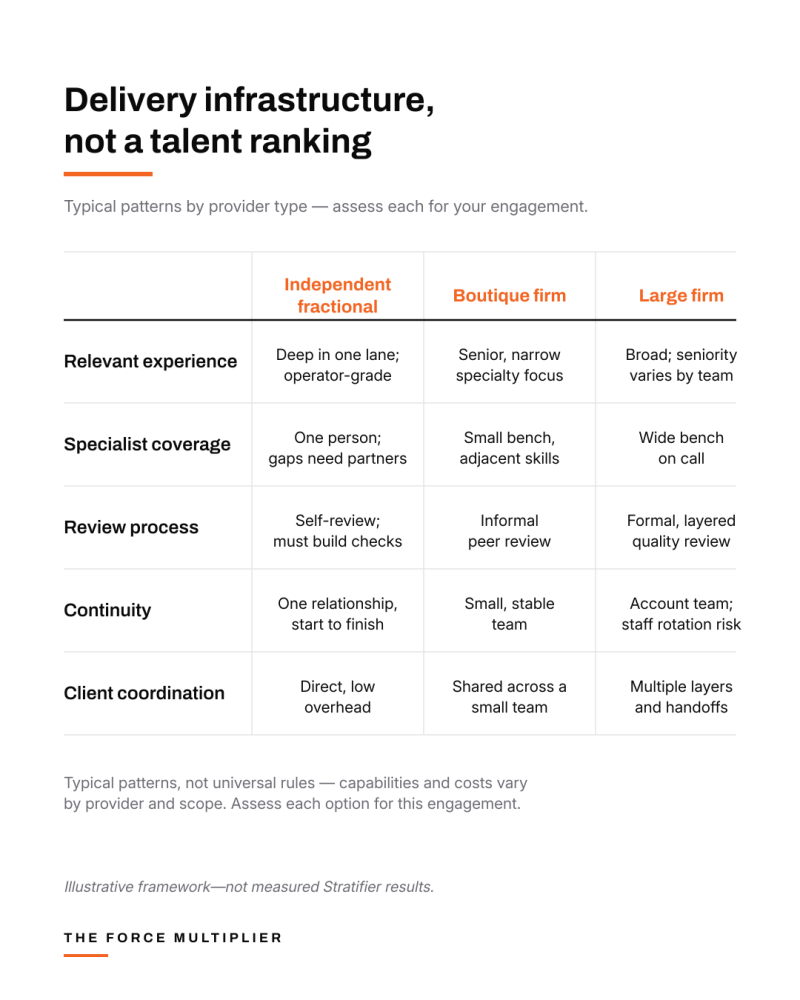
A firm may win on review and specialist depth and lose on cost and continuity. An independent may win on talent and fit and leave a gap on review. When these get mixed together, the client makes a worse decision, and the independent loses work she should have won. The opposite also happens: she wins work she shouldn't have taken.
The cost of that confusion falls on the client. If they pick on reputation, they may pay for coverage they never use. If they pick on rapport, they may end up with no second check on numbers headed to a lender.
A method: build three profiles, not one verdict
Before the next competitive proposal, write out three honest profiles: independent fractional, boutique firm, and large firm. Score each against what this client needs, not against an ideal.
- Relevant experience. Has the lead done this exact kind of work, at this size and in this industry?
- Specialist availability. Which specialist questions will this engagement probably raise, and who answers each one?
- Independent review. Who checks the work, and when? Write down a name, not "as needed."
- Continuity. Who will be doing the work in month five? Firms sometimes rotate staff. An independent might get sick.
- Coordination cost. How many hours will the client's own team spend briefing, waiting and repeating context?
- Fit. How well does each option match the culture, pace and how much the owner wants to be involved?
Then sort the gaps into two groups. Some are delivery gaps: keeping context, producing consistent and professional deliverables, keeping the work moving between meetings. Better systems can address these. Others are capacity gaps: specialist credentials, a true second reviewer, extra people for a deadline. Those need human partners. Software can't stand in for them, and saying otherwise damages your credibility.
A worked example (made up)
A fictional manufacturer with $40M in revenue needs an annual planning engagement. It considers three options:
- An independent CFO who has worked in this industry and is available every week.
- A finance boutique with three senior people and an in-house tax specialist.
- A multidisciplinary firm offering finance, operations and IT advisory under one contract.
If the main need is a credible operating plan led by the owner, built in weeks and kept in place afterward, the independent may be the best fit, as long as she names an outside reviewer for the financial model.
If the plan depends on a restructuring with tax consequences, the boutique's in-house specialist may decide it.
If the plan includes an ERP replacement and a multi-site reorganization at the same time, the large firm's coordinated coverage may be worth its overhead.
No option wins in every case. The client's requirements decide, which is why the profiles matter more than reputations.
The fair counterargument
Many boutiques run on little overhead and have expertise no independent can match. Some independents charge more than firms, and should, because of what they've done. Large firms sometimes deliver faster because they can put people on a problem at once. Research on the consulting market, such as Harvard Business Review's 2013 analysis of disruption in consulting, describes how the industry was splitting into different delivery models. It doesn't show that any one model is cheaper or better today. No universal ranking holds up. The honest position: it depends on the requirement, and here is how to tell.
Where a platform helps, and where it doesn't
This is where Stratifier fits, within limits. It keeps the client's business context saved in one place, so discovery doesn't restart every time someone new joins or a new phase begins. It produces branded, consistent deliverables, so the independent's work looks like it came from an organized practice. Those features address delivery gaps.
They don't provide a second reviewer, a tax credential or extra people for a deadline. The fractional still owns the judgment, the review arrangement and the honest statement of what she can't cover. Any efficiency she expects, such as fewer re-briefing hours or fewer review rounds, is something to test with that client. Measure it in client person-hours and in calendar days separately, and check it against the quality of the work. It is not a promise.
One action to test this month
On your next proposal, add a one-page "coverage map": each required area of expertise, who covers it, and who reviews it. Note any gap you'd fill with a named partner. Then watch whether the board's question changes from "who checks your work?" to "when can you start?"
What does your client need that you cannot responsibly provide alone?
If you want to pressure-test your delivery approach, message Jamie Jansen about where Stratifier might help—and where it would not.
Free Fractional Business Health Assessment with a 2-Year Plan to put your business on cruise control.
https://stratifier.nextrockadvisors.com/fractional-assessment